How to Qualify a Chinese Wine Importer Before Sending Samples
Sending wine samples to China without rigorous vetting burns export budgets and risks regulatory delays. Learn how to qualify a Chinese wine importer using official registration checks, customs licensing requirements, and commercial alignment before dispatching bottles.
Shipping wine samples into mainland China without systematic qualification is one of the fastest ways for export managers to erode margin. Between specialized temperature-controlled air freight, customs documentation, duty liabilities, and clearance protocols overseen by the General Administration of Customs of China (GACC), dispatching a six-bottle carton often costs between €300 and €600. When international brands distribute samples to unvetted leads, they frequently discover too late that the recipient lacks an alcohol import license, operates purely as a broker, or simply wanted free inventory.
Qualifying a Chinese wine importer before sending samples requires a structured, multi-tier vetting protocol. By verifying official company registration, GACC filing readiness, regional distribution channels, and commercial portfolio alignment, wineries can protect their operational budgets and focus on buyers capable of generating sustainable reorders.
Step 1: Legal Existence and Official Enterprise Verification
In China, English trade names hold no statutory standing in commercial disputes. Every legitimate corporate entity is registered under an official Chinese name and possesses an 18-digit Unified Social Credit Code (USCC). Conducting primary due diligence before sharing commercial price lists or shipping samples starts with formal corporate checks.
The National Enterprise Credit Information Publicity System (GSXT)
As outlined in operational due diligence guidance by FDI China (2025), the primary official database for corporate verification is the National Enterprise Credit Information Publicity System (GSXT), administered by the State Administration for Market Regulation (SAMR).
Request the prospective importer’s business license (Yingye Zhizhao) and verify the following data points on the official GSXT platform:
- Operating Status: Ensure the status is "Active" (Cunxu or Kaiye) rather than revoked, suspended, or in liquidation.
- Registered Capital and Paid-In Capital: Review the capital scale against the scope of their distribution operations.
- Business Scope (Jingying Fanwei): Confirm the legal scope explicitly permits wholesale food and beverage distribution and alcoholic beverages (Jiulei).
- Legal Representative and Shareholding Structure: Identify whether the operational contact possesses written authority or power of attorney to negotiate on behalf of the registered entity, a crucial fraud prevention step documented by the EU SME Centre (2026).
- Administrative Penalties & Blacklists: Review SAMR records for serious illegal acts, consumer fraud citations, or severe irregular operational listings.
Step 2: Customs Licensing, GACC Status, and Import Capacity
Many entities presenting themselves as direct importers at trade events are actually secondary regional wholesalers, private-client retailers, or commissioned brokers. While these buyers play vital roles in the distribution ecosystem, they cannot clear foreign wine through customs in their own name.
Direct Importer vs. Domestic Agent
To legally import bottled wine, a Chinese entity must possess:
- An operational Customs Registration Code (CR Code) issued by GACC.
- Registration on the China Inspection and Quarantine (CIQ) enterprise filing system for imported food and cosmetics.
- An active import/export business qualification endorsement.
If the prospective buyer does not hold an import license, ask which licensed import agent (Waimao Daili) they employ to manage import clearance, port handling, and customs declaration value filings. If an intermediary is used, verify whether your sales contract will be executed with the distributor, the end buyer, or the licensed agency.
Label Compliance and Regulatory Realities
Under regulations maintained by the General Administration of Customs of China (GACC), imported wine entering commercial circulation must bear an approved Chinese back label outlining the product name, alcohol content, ingredients (including preservatives/sulfites), country of origin, net volume, storage conditions, and the mandatory name, address, and phone number of the mainland distributor or importer. Verifying that your contact understands local Chinese back-label requirements—rather than asking you to send unlabelled or non-compliant bottles—is an immediate indicator of operational maturity.
Step 3: Assessing Commercial Fit and Portfolio Alignment
Beyond administrative compliance, a qualified importer must possess clear market synergy with your winery’s varietals, production capacity, and price tiers.
The Direct Questioning Framework
Before agreeing to absorb sample freight, require the buyer to answer five operational qualifying questions:
- Which distribution channels do you actively manage? (e.g., Tier-1 on-trade dining, corporate gifting, regional sub-distributors, specialized wine retail, or live-stream e-commerce platforms).
- Which geographic territories do you cover? China cannot be served as a single consolidated market. Importers frequently excel in specific provincial clusters, such as the Pearl River Delta/Guangdong, the Yangtze River Delta (Shanghai/Zhejiang/Jiangsu), or Northern municipal hubs. Ensure their network matches your export strategy.
- What existing wine origins and price bands comprise your portfolio? A portfolio loaded with entry-level bulk-bottled European table wines rarely succeeds with high-end single-vineyard biodynamic estates. Conversely, an importer focused solely on classified Bordeaux growths will struggle to move commercial-volume New World varietals.
- What is your target Free On Board (FOB) price and expected landed retail multiplier? In mainland China, freight, insurance, customs duties, consumption tax, value-added tax (VAT), and tier margins typically result in shelf prices 3 to 4 times the FOB cellar price, as highlighted by BestWineImporters (2026). If the importer expects your €8 FOB wine to retail at €12, their unit economics are fundamentally unrealistic.
- What is your proposed marketing and promotional commitment? Review whether the buyer has dedicated sales personnel, local warehousing with thermal stabilization, and a concrete schedule for brand-building tastings or channel promotions.
Practical Due Diligence: 4-Tier Qualification Matrix
Use this operational evaluation matrix before authorizing the dispatch of wine samples:
| Assessment Tier | Core Verification Indicator | Required Documentation / Verification Source | Risk Level if Missing | | :--- | :--- | :--- | :--- | :--- | | Tier 1: Legal Existence | Active registration and legitimate corporate status | Unified Social Credit Code verified via SAMR / GSXT database | Critical / Stop: Potential ghost entity or consumer scam | | Tier 2: Regulatory Authority | Direct customs clearance or established agency partnership | Customs Registration (CR) Code or valid third-party agency agreement | High: Goods held at port or sample clearance failures | | Tier 3: Commercial Capability | Active distribution channels and warehouse infrastructure | Portfolio catalogue, verified retail/on-trade distribution list, temperature-controlled warehouse proof | Moderate to High: Ineffective channel placement or speculative sampling | | Tier 4: Professional Validation | Industry reputation and established supply relationships | Trade association references, presence in organized B2B sourcing sessions | Low to Moderate: Misaligned sales expectations or slow commercial conversion |
The Sample Cost Trap: A Hypothetical ROI Model
Unvetted sample distribution directly undermines export profitability. Below is a hypothetical evaluation illustrating the financial advantage of disciplined qualification versus uncurated sample dispatch across a 12-month commercial campaign.
Hypothetical Model Assumptions
- Sample Kit: 6 bottles per target buyer (average product cost: €10/bottle = €60).
- Logistics & Clearance: Air freight, express clearance, and thermal packing = €340 per shipment. Total sample package cost = €400.
- Commercial Conversion: 1 successful initial order = 1 pallet (1,200 bottles) at €10 FOB = €12,000 gross revenue.
- Winery Contribution Margin: 35% (€4,200 gross contribution margin per converted partner).
Scenario A: Unfiltered Sampling (Spray-and-Pray)
- Sample requests fulfilled without GSXT/licensing checks: 30 shipments.
- Total sampling expenditure: 30 × €400 = €12,000.
- Conversion rate: 3.3% (1 converted buyer out of 30 due to unvetted leads and ghost contacts).
- Total Gross Contribution Earned: 1 × €4,200 = €4,200.
- Net Sampling Profit/Loss: €4,200 - €12,000 = -€7,800 net commercial loss.
Scenario B: Rigorous Buyer Pre-Qualification
- Prospective leads evaluated: 30.
- Leads passing Tier 1–Tier 3 checks: 8 vetted importers.
- Total sampling expenditure: 8 × €400 = €3,200.
- Conversion rate among pre-screened importers: 25% (2 converted buyers).
- Total Gross Contribution Earned: 2 × €4,200 = €8,400.
- Net Sampling Profit/Loss: €8,400 - €3,200 = +€5,200 net commercial contribution.
Systematic qualification saved €8,800 in unrecoverable freight and packaging costs while doubling the volume of commercial trading accounts.
Structured Sample Dispatch Policy
To ensure your sampling program remains commercially sound, implement a transparent written policy for international prospective buyers:
- Pre-Shipment Consultation: Require an introductory 20-minute video conference or structured intake questionnaire covering target retail pricing and channel placement.
- Freight Cost Sharing: For cold inquiries originating online or via unsolicited email, offer to provide samples free of charge on the condition that the prospective importer arranges collection via their own courier account (DHL/FedEx) or reimburses express delivery costs. Serious importers with immediate purchasing interest routinely accept this condition.
- Credit on First Commercial Order: Commit in writing to credit 100% of the sample and shipping costs back to the importer on their first container or pallet order.
- Thermal Window Planning: According to logistics guidelines for shipping wine to China, avoid shipping small sample packages via air express during peak summer heat waves (July–August) without validated thermal insulation, as cargo holds and customs tarmac staging can easily exceed 35°C, ruining the wine before the tasting occurs.
Moving from Inquiries to Pre-Qualified Face-to-Face Sourcing
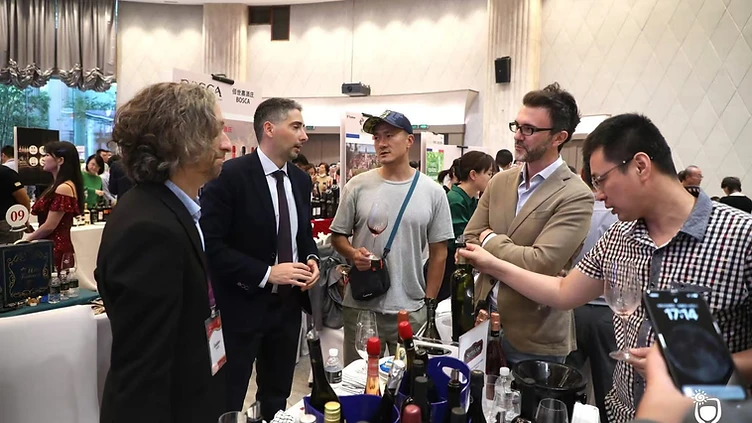
While remote desktop vetting reduces fraud, the most reliable qualification happens when export managers meet importers who have already been screened for active licensing and purchasing volume. Curated commercial environments allow brand owners to observe an importer's professional presence, market knowledge, and regional reputation in real time.
Producers seeking structured access to verified Chinese and Asian distributors can participate in specialized Business Matching programs, examine ongoing distributor movements through our Wine Import & Distribution knowledge hub, and review active market operators within the Exhibitor Directory.
Wineries preparing their long-term Greater China and Southeast Asian release calendar can coordinate their market visits around the following major trade milestones:
- Guangzhou 2026: 16–18 November 2026
- Hanoi Roadshow 2026: 20 November 2026
- Spring Guangzhou 2027: 7–9 May 2027 at the China Import and Export Fair Complex / Pazhou, Guangzhou
- Asia Roadshow 2027: Hanoi (11 May), Kuala Lumpur (13 May), Singapore (15 May), and Bali (17 May)
- Vietnam 2027: 6–8 July 2027 at SECC, Ho Chi Minh City
- Autumn Guangzhou 2027: 31 October–2 November 2027 at the China Import and Export Fair Complex / Pazhou, Guangzhou
Establishing professional qualification standards today ensures your samples land in the glasses of legitimate, fully licensed wine buyers capable of scaling your brand across mainland China.
Sources
- EU SME Centre (2026). How to conduct primary due diligence in China? https://www.eusmecentre.org.cn/faq/how-to-conduct-primary-due-diligence-in-china/
- FDI China (2025). Chinese Company Due Diligence Checklist: How to Verify a Company Step by Step. https://fdichina.com/blog/chinese-company-due-diligence-checklist/
- BestWineImporters (2026). A Wine Exporter’s Guide to Finding Buyers in China and Working with Chinese Wine Importers. https://www.bestwineimporters.com/blog/resources/a-wine-exporters-guide-to-finding-buyers-in-china-and-working-with-chinese-wine-importers/
- U.S. Alcohol and Tobacco Tax and Trade Bureau (2025). People's Republic of China (PRC) Export Requirements. https://www.ttb.gov/import-export/itd/people-s-republic-of-china
Key Takeaways
- —Verify the prospective importer’s official 18-digit Unified Social Credit Code and active registration on the official GSXT database before shipping samples.
- —Confirm whether the buyer holds a direct GACC customs registration code or utilizes an authorized import agency.
- —Evaluate channel positioning and landed price calculations to ensure the importer's business model fits your wine's FOB price point.
- —Adopt a formal sample policy, such as sample fee crediting on initial orders, to filter out casual inquiries and hobbyists.
- —Avoid shipping air-freight samples during peak summer heat periods unless strict thermal protection is guaranteed across tarmac and customs clearance.
Frequently Asked Questions
Can I verify a Chinese wine importer's business license using an English company name?
No. English company names have no official legal standing in mainland China. You must obtain the enterprise's registered Chinese name and its 18-digit Unified Social Credit Code to verify corporate status on the National Enterprise Credit Information Publicity System (GSXT).
What import licenses are required to clear bottled wine into China?
A direct importer must hold an operational business license with an alcoholic beverage business scope, a Customs Registration Code (CR Code) from GACC, and valid enterprise registration under the imported food and cosmetics filing system. If they lack these, they must use a licensed import customs agency.
Should a winery pay for sample shipping to China?
For unsolicited or cold leads, wineries should require the prospective buyer to cover shipping via their international courier account or commit to reimbursing sample freight against their first commercial order. This simple filter weeds out low-intent contacts and consumer sample collectors.
Why is thermal control critical when dispatching samples to China?
Air express shipments frequently sit on airport tarmacs or in unconditioned customs warehouses where temperatures can exceed 35°C during summer months. Heat exposure can cook the wine, resulting in false negative quality assessments by serious prospective buyers.