Interwine Guide to Exhibition booth planning
A commercial, step-by-step Interwine guide to exhibition booth planning for wineries, exporters, and international brands targeting China and the broader Asia-Pacific wine trade.
Exhibition booth planning for major wine trade shows is fundamentally an operational and commercial exercise rather than a mere decorative task. For international wineries, brand owners, and export managers entering or expanding within China, an exhibition stand serves as a high-throughput tasting counter, an importer negotiation room, and a physical representation of estate pedigree. At large-scale gatherings such as Interwine in Guangzhou—which spans up to 50,000 square meters and convenes over 50,000 professional trade buyers and importers across major sessions, as reported by Beverage Trade Network (2024)—an unorganized stand causes friction, delays sample presentation, and dilutes commercial return on investment (ROI).
Executing a high-performing booth requires an integrated timeline that coordinates structural footprint selection, sample temperature control, bilingual visual communication, and structured buyer meetings. Producers planning to become an exhibitor must build an actionable booth strategy from the ground up to secure distribution partnerships across Southern China and nationwide channels.
Stand Layout Architecture: Balancing Flow and B2B Negotiations
A critical mistake made by first-time exhibitors is failing to segment their floor area by operational intent. Trade exhibition venues host two distinct profiles of visitors: casual trade samplers evaluating broad portfolio entries and serious commercial buyers (regional distributors, private-label consolidators, hospitality beverage directors) requiring commercial privacy. Exhibition logistics analysis by Global Experience Specialists (GES, 2025) demonstrates that professional stands must be engineered around clear visitor pathways, functional furnishings, and deliberate operational zones.
+-------------------------------------------------------------+
|                      STORAGE & UTILITY                       |
|  [Sample Crates | Back-Stock Glassware | Wine Fridge/Ice]   |
+-------------------------------------------------------------+
|                     SEMI-PRIVATE NEGOTIATION                |
|      [Round Meeting Table | Spec Sheets | Contract Terms]   |
+-------------------------------------------------------------+
|                     ACTIVE TASTING BAR                       |
|    [Chilled Displays | Spittoons | Clean Glassware Staging]  |
+-------------------------------------------------------------+
|                        AISLE / VISITOR FLOW                  |
+-------------------------------------------------------------+
1. The Active Frontline (Tasting Station)
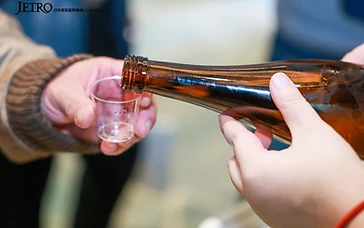
Position this counter directly facing the aisle to capture qualified foot traffic without bottlenecking the entrance. Staff this zone with tasting coordinators who can quickly identify the buyer’s category interest (e.g., bulk supply, estate bottled, sparkling, or retail price points) and offer standard 30ml sample pours.
2. The Semi-Private Commercial Zone
Equip this section with seated tables away from the noise of the primary gangway. Once a prospective importer validates taste profiles, move them to the commercial table to discuss Minimum Order Quantities (MOQs), free-on-board (FOB) or delivered-at-place (DAP) pricing, Incoterms, and territorial exclusivity.
3. Back-of-House Storage and Wine Preparation
A wine booth cannot function without dedicated, concealable storage. Ensure this area accommodates extra glassware racks, dump buckets, washing supplies, promotional brochures, and temperature-controlled refrigeration or insulated ice-chambers.
Critical Wine Logistics: Sample Stewardship, Glassware, and Service
Wine stands have distinct physical requirements that standard industrial trade booths do not. Presentation quality directly impacts perceived bottle value.
| Operational Factor | Standard Configuration | Commercial Wine Exhibition Best Practice | | :--- | :--- | :--- | | Sample Temperature | Ambient room temperature (often 22°C–25°C in exhibition halls) | Dual-zone wine fridges or organized chilling tubs (Whites/Sparkling: 6°C–9°C; Reds: 15°C–18°C) | | Glassware Inventory | 12–20 generic glasses washed intermittently | Minimum 60–100 ISO tasting glasses per 9sqm; reserved stems for VIP negotiation table | | Dump Buckets & Water | 1 central spittoon on main counter | Individual spittoons spaced every 1.5 meters; dedicated water jugs for glass rinsing and hydration | | Bottle Disposal | Standard wastebasket | Reinforced, leak-proof collection bins for heavy glass bottle cycling |
As trade authorities such as the Wine & Spirit Education Trust (WSET, 2017) emphasize, managing physical sample integrity and workflow readiness across multi-day exhibitions dictates commercial outcomes. Serving a high-tier red wine at 25°C or a white wine lukewarm due to power drops diminishes sensory appeal and hurts negotiation leverage. Review venue power feeds early to secure reliable 220V drop lines for dedicated wine refrigerators.
Visual Merchandising and Chinese Localization
Trade show graphics in international halls must communicate critical commercial facts within four seconds of visual scanning. A common pitfall for European, South American, and Australasian producers is displaying purely artistic lifestyle imagery without commercial context.
- Bilingual Typography & Data Blocks: Ensure estate names, grape varieties, regions/appellations, and alcoholic strengths are printed legibly in both English and Simplified Chinese. Incorporate verified Chinese brand names (zhōngwén pǐnpái) if already registered under the China National Intellectual Property Administration (CNIPA).
- Prominent Commercial Badging: If your wines hold international distinctions, highlight them clearly. According to Beverage Trade Network (2024), structured integrations between international wine competitions and trade shows give buyers immediate benchmarks for quality. Prominently display competition medals, organic/biodynamic certifications, and recognized scoring bands (90+ points).
- QR Code Integration: International business cards often fail to bridge communication gaps post-event. Integrate large, easily scannable WeChat corporate QR codes directly into counter graphics, banner displays, and sell sheets. Chinese distributors, regional retailers, and sommeliers utilize WeChat for real-time portfolio inquiries, digital catalog reviews, and trade messaging.
Exhibitors seeking broader market context and consumption patterns across Southern China's premium alcohol sector can review current analysis via Market Insights to adjust their price-point graphics accordingly.
The Exhibition Planning Timeline: Countdown to Floor Opening
Executing a seamless trade booth requires disciplined scheduling. The trade exhibit production framework documented by GES (2025) emphasizes locking in booth construction parameters and logistical services well ahead of discount cutoffs to prevent operational failures.
[T-16 to T-12 WEEKS] -> Stand Reservation & Footprint Selection
[T-12 to T-8 WEEKS]  -> Sample Shipping, CIQ Documentation & Freight Clearance
[T-8 to T-4 WEEKS]   -> Bilingual Creative Proofing, Electrical & AV Booking
[T-4 to T-2 WEEKS]   -> Pre-Fair B2B Matching & Distributor Appointment Booking
[T-1 WEEK to D-DAY]  -> On-Site Move-in, Glassware Inspection & Cold-Chain Prep
16 to 12 Weeks Out: Stand Reservation and Classification
Select your stand footprint: shell scheme (standard turnkey modular booth) or raw space (custom fabrication). For wineries entering the market or working with introductory budgets, an upgraded shell scheme equipped with branded fascia, lockable storage, and rented display towers offers low-risk efficiency. Raw space is best suited to national pavilions, established import consortia, or estates requiring custom brand environments. Finalize your contract via the become an exhibitor portal.
12 to 8 Weeks Out: Regulatory Paperwork and Sample Freight
Ensure customs clearance documentation, non-commercial sample declarations, and General Administration of Customs of China (GACC) producer registrations are current. Consign your promotional stock through licensed freight forwarders familiar with wine logistics. Consult the Exhibitor Directory to benchmark portfolio offerings and assess competitor density.
8 to 4 Weeks Out: Electrical, Furniture, and Translation Sign-Off
Submit electrical requests for chillers, LED spotlights, and washbasin access. Standard shell schemes rarely include internal plumbing; order daily commercial water supplies and glassware sanitization services. Finalize print runs for bilingual tech sheets and digital catalogs.
4 to 2 Weeks Out: Direct Buyer Pre-Engagement
Do not rely entirely on open-floor aisle foot traffic. Use Business Matching services to lock in 30-minute commercial tasting slots with pre-screened importers and enterprise buyers prior to opening day.
Staffing: Technical Sommelier Expertise vs. Negotiation Authority
A trade booth requires staff with complementary capabilities. The Wine & Spirit Education Trust (2017) notes that trade exhibitions require clear operational alignment between technical brand storytelling and commercial deal closure. Operating an international wine booth requires three distinct capabilities:
- The Technical Brand Advocate: A winemaker, estate owner, or accredited educator (e.g., DipWSET) who can articulate terroir, vintage variance, oak treatments, and sensory profiles during sensory trials.
- The Commercial Decision Maker: An export director or commercial lead empowered to negotiate container volumes, payment schedules (e.g., Letter of Credit or wire transfers), logistics consolidation, and distributor territories.
- The Bilingual Trade Interpreter: A local wine professional fluent in Mandarin and the producer's native language who understands wine terminology (dānníng for tannins, suāndù for acidity, chǎnqū for appellation) to eliminate misunderstandings during price negotiations.
Lead Capture and Post-Show Follow-Up Protocols
Trade show success is measured by contracts signed and orders shipped in the 90 days following the event. A systematic lead classification method prevents lost momentum:
- Tiered Categorization at Point of Contact:
- Category A: Importers/distributors with active import licenses, established logistics infrastructure, and immediate volume requirements. Target follow-up: within 48 hours.
- Category B: Niche distributors, sub-regional wholesalers, or multi-unit on-premise accounts requesting commercial samples and pricing matrices. Target follow-up: within 5 working days.
- Category C: General trade observers, private consumers, or unverified brokers. Direct them to digital channels and brand WeChat accounts.
- Digital Record-Keeping: Stapling business cards to paper forms leads to lost data. Use integrated digital scanning tools to capture badge data and associate voice notes or mobile snapshots of tasted wines immediately with each contact record.
- Post-Event Sample Dispatch: Coordinate prompt domestic sample dispatches from in-market warehouses for high-priority Tier A contacts who require formal bench tastings with their internal buying committees.
By uniting functional booth zoning, proper temperature controls, targeted bilingual messaging, and disciplined commercial follow-up, international wine producers can transform trade show presence into sustainable sales channels across the Chinese market.
Sources
- Beverage Trade Network (2024) - China Wine Competition Partners With Interwine China
- GES (2025) - Exhibition Booth Design Guide for Trade Show Success
- Wine & Spirit Education Trust (WSET, 2017) - Survival Guide to Wine Trade Shows
- SevenFifty Daily (2023) - A Winery Guide to Trade Show Success
Key Takeaways
- —Segment the booth into three distinct operational zones: an active frontline tasting counter, a semi-private negotiation table, and back-of-house sample storage.
- —Plan dedicated refrigeration and electrical infrastructure early to avoid serving wines above target temperatures in high-traffic halls.
- —Display bilingual (English and Simplified Chinese) tasting assets, technical specifications, and scannable corporate WeChat QR codes.
- —Coordinate staff roles to balance technical oenological storytelling with commercial negotiation authority and bilingual interpretation.
- —Engage pre-show matching services 2 to 4 weeks prior to opening day to secure qualified distributor meetings rather than relying only on walk-up foot traffic.
Frequently Asked Questions
What is the ideal booth size for a winery at Interwine?
A standard 9 to 18 square meter booth is generally ideal for individual wineries showcasing 6 to 12 SKUs. This provides adequate room for a front-facing tasting bar, basic wine chilling equipment, and a seated negotiation table. Larger estates, generic wine bodies, or multi-brand consortia typically book 36 square meters or more of raw space to construct custom pavilions with private meeting suites.
How many sample bottles should an exhibitor prepare for a 3-day wine fair?
As a standard rule of thumb, prepare 2 to 3 bottles per SKU for each full exhibition day if pouring controlled 30ml trade samples. For an 8-wine portfolio across a three-day fair, plan for approximately 48 to 72 bottles. Maintain additional reserve stock in off-site consolidation warehouses for high-priority Tier A buyers who request complete unopened sample sets for evaluation.
Should international producers choose a turnkey shell scheme or raw space?
Turnkey shell schemes are recommended for first-time exhibitors or wineries operating with streamlined budgets, as walls, fascia boards, lighting, and carpet are pre-fitted by the organizer. Raw space requires contracting an approved external stand builder and is better suited to established brands, national promotion agencies, and regional pavilions seeking custom architectural designs.
How do exhibitors manage wine chilling logistics without built-in water or drain lines?
Shell scheme booths do not feature plumbing. Exhibitors should rent plug-in commercial wine display fridges through the organizer’s official contractor well in advance. For white and sparkling wines, combine display refrigerators with tabletop acrylic chillers and insulated ice tubs. Secure scheduled ice deliveries from venue catering services and maintain sealed drainage buckets in the storage zone.
How can an international exhibitor capture and qualify Chinese distributor leads efficiently?
Relying on printed business cards alone creates high administrative drop-off. Set up an official company WeChat profile with integrated digital sell sheets and high-resolution product photography. Place scannable WeChat QR codes prominently on counter fascias and table mats so visiting buyers can connect instantly, and log buyer requirements in real time.